Nov 03, 2026
Daycare vs. Preschool vs. Pre-K: How to Compare & Choose a Program for Your Child
10 min read
Most children move through daycare, preschool and pre-K on their way to kindergarten, sometimes within the very same classroom. Daycare, for instance, centers on supervised care, while preschool and pre-K focus on structured early education, each suited to a different age and stage of your child’s growth.
As the Leader in Early Education and Care® for more than 40 years, we’ve guided families through each stage of early childhood development, from infancy through elementary school.
Today, we will guide you through what each stage offers your child, the research behind it and how to know which one is the right fit for your family.
What Is Daycare?
Daycare is full-day, year-round supervised care for children from 6 weeks through age 5 or 6, built around a working parent’s schedule.
It is supervised care families can count on across a full workday, since most daycare programs open early, close late and run year-round with few closures.
The wide age range typically means that your child could grow up in the same building for years, moving from the infant room to the toddler room to a preschool-age classroom, with siblings sometimes right down the hall from each other.
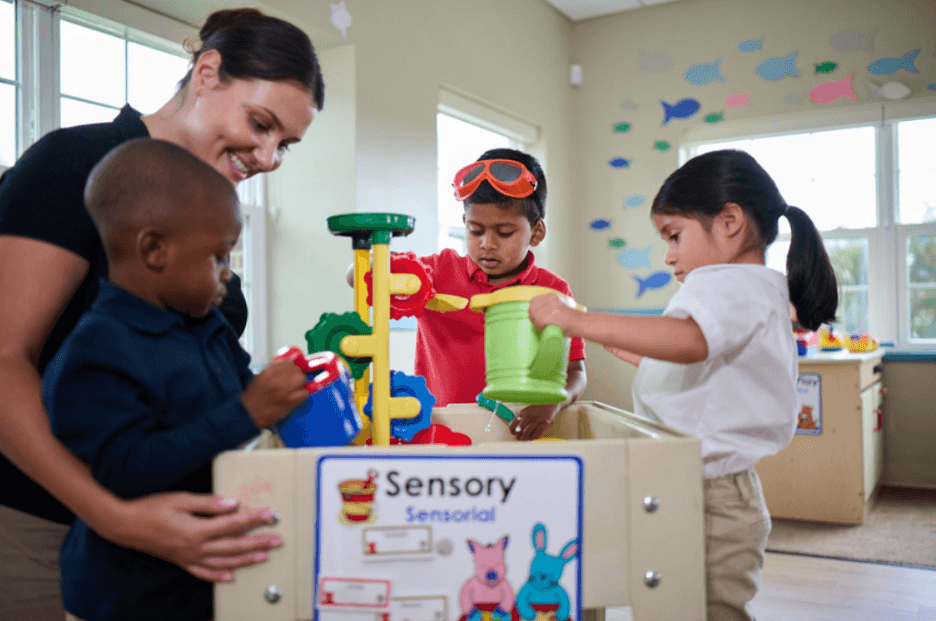
Daycare centers are primarily designed to provide care, most notably in the infant and toddler rooms. At Primrose, even the Infant and Toddler classrooms follow a predictable daily routine and schedule with intentionally designed, inquiry-based learning experiences. Teachers use songs, stories and sensory exploration to help children explore concepts tied to the unit of learning, and the day still makes room for early language, diaper changes and snack time.
If your family needs full-day coverage every week of the year, daycare provides that foundation.
🧩 More From Primrose Teachers: 4 Steps for a Better Morning Routine
What Is Preschool?
Preschool is a school-year program, usually for ages 2½ through 4, focused on your child’s social and emotional growth through play.
It follows a school-year calendar rather than a full-time work schedule. Most schools or preschool programs close for summers and holidays or offer shorter daily hours and sometimes a half-day option.
At Primrose, this stage typically lives in the Preschool classroom for 3-year-olds. Children whose birthdays fall close to the kindergarten cutoff may instead spend time in Preschool Pathways, a bridge classroom that keeps them with the same group of peers through preschool, pre-K and kindergarten.
Preschool is designed to build your child’s ability to be part of a group, almost entirely through play. For instance, children may be asked to take turns with a favorite toy, wait their turn at the sink and follow the same simple routine each morning until it feels automatic.
If your schedule doesn’t line up neatly with a school-day calendar, we recommend asking whether a program offers extended-day coverage, and whether your child needs to be potty trained to start, since both vary from center to center.
What Is Pre-K?
Pre-kindergarten (pre-K) is the year immediately before kindergarten, usually for 4- and 5-year-olds, with a greater focus on kindergarten readiness than preschool alone provides.
Schedules can vary more than at daycare or preschool. Some pre-K programs run half days and others run full days. Some follow the school calendar, while others extend through the summer.
At Primrose, most 4-year-olds move into the Pre-Kindergarten classroom. Children who could use more time before starting elementary school, or who join Primrose later and miss the kindergarten birthday cutoff, may continue on in Transitional Kindergarten, a bridge between Pre-K and Kindergarten.
Pre-K builds on what your child already learned in preschool, layering in more deliberate teaching in early literacy, number sense and the self-regulation skills a kindergarten classroom expects on day one.
Children who start kindergarten already comfortable with early academics and self-regulation tend to stay ahead.
Early math skills predict later school success more reliably than almost any other early measure, with reading and attention skills close behind, a pattern Greg Duncan and his research team documented after following children across six long-term studies published in Developmental Psychology in 2007.
The biggest gains show up in classrooms that stay academically focused while teachers respond warmly to a child’s curiosity, according to Robert Pianta and his research team, who studied nearly 1,500 children across a year of pre-K classrooms.
So, when choosing a pre-kindergarten program for your child, we recommend assessing the academic program shoulder to shoulder with the school’s approach to nurturing children’s character and social development.
🧩 More From Primrose Teachers: Is My Child Ready for Kindergarten?
How to Compare Daycare, Preschool & Pre-K Options
Let us summarize what we have learned about daycare, preschool and pre-kindergarten programs so far:
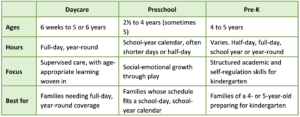
As you have probably discovered in your research so far, the exact definition of and approach to any of these three programs change from school to school.
Infant and Toddler programs at Primrose combine education and care, while a similar program at another school may focus on care only.
This is why we recommend that parents focus on matching a program to their family’s and their child’s needs, rather than the other way around.
How to Choose the Right Program for Your Child
To help you create or complete your program selection checklist, we will look at the accreditation standards early childhood experts use to define quality, and the questions we hear most often from families touring a Primrose classroom.
The 2025 Early Childhood Program Standards from the National Association for the Education of Young Children (NAEYC) define what a high-quality early learning program looks like, from teacher qualifications to how a classroom tracks each child’s progress.
There are four benchmarks to highlight when comparing daycare, preschool and pre-kindergarten programs:
- Trained educators: What kind of early childhood training do the teachers have?
- Small class sizes: How many children share each classroom with a teacher?
- Active engagement: How do teachers talk and connect with children throughout the day?
- Ongoing assessment: How does the program track each child’s progress over time?
To tailor the checklist to your family’s requirements, also consider:
1. Your Child’s Readiness
Watch how your child handles everyday moments, such as moving from one activity to the next calmly, following directions with two or three steps and staying engaged through a short activity like a story or a simple craft.
NAEYC calls this kind of readiness a state of mind, built through moments like these, rather than a list of facts a child has memorized.
These signals point toward pre-K’s faster, more academic pace. If your child isn’t quite there yet, a more flexible, play-based setting gives them room to grow into it.
If you are uncertain about your child’s readiness, your nearest Primrose school can provide insights and recommendations.
2. Your Family’s Schedule
Look closely at the schedule your family keeps.
If your work leaves little flexibility, a year-round program with extended hours will likely serve you better, while a half-day program can work well if you have some flexibility, or extra help from family.
Bonus: What to Ask on a Tour
These are the questions we hear most often from families touring a Primrose classroom, and they apply just as well anywhere you tour:
- How does the program keep families updated day to day?
- What’s the approach to guiding behavior when children have a hard moment or a conflict with a classmate?
- What health and safety protocols are in place, from daily check-in to illness policy?
- How does the program support your child’s transition into the next classroom, or into kindergarten?
For a longer version to bring with you, Child Care Aware’s preschool checklist covers everything from safety to staff qualifications.
🧩 More From Primrose Teachers: Your Family’s Guide to Child Care
Frequently Asked Questions About Daycare, Preschool and Pre-K
These are the questions parents ask us most often once they’ve narrowed down their options.
1. Is pre-K the same as kindergarten?
No, pre-K comes one year before kindergarten and focuses on getting your child ready for it. Kindergarten is the first year of formal elementary school, with its own state academic standards.
2. Can my child do preschool and daycare at the same time?
Yes, you can combine a morning preschool or pre-K program with daycare-style care for the rest of the day. This is a common setup when family and school schedules don’t quite line up on their own.
3. Does it matter if my child goes to daycare instead of pre-K?
Not really. Well-run daycare centers and preschools, with trained teachers and plenty of hands-on learning, can prepare your child for kindergarten just as well as a dedicated pre-K program.
4. Do I need to switch programs as my child moves from daycare to preschool to pre-K?
Not necessarily. If your center offers all three stages, your child can move through each one without changing buildings, teachers or overall approach. If your current program only covers part of that range, ask on a tour how they support the transition to the next stage.

How Primrose Schools Supports Your Child From Infant Care Through Pre-K
Primrose Schools is The Leader in Early Education and Care. For more than 40 years, we have served children from six weeks to 12 years old.is the Leader in Early Education and Care®. For more than 40 years, we have served children from six weeks to 12 years old.
Wherever your child is in this progression, Balanced Learning® is the approach behind their classroom. It blends purposeful play with nurturing guidance from teachers, building curiosity, creativity, confidence and compassion, what we call Active Minds, Healthy Bodies and Happy Hearts®, from infancy through pre-kindergarten.
Across Primrose classrooms, that approach shows up in specific ways:
- Wonder Time™ and Small Group Learning. In the Wonder Program™ (Infant through Preschool Pathways), Wonder Time™ starts in the Infant classroom as one-on-one interaction and grows into small-group play as your child gets older. In the Venture Program™ (Preschool through Kindergarten), Small Group Literacy and Small Group Math guide children to explore math and literacy experiences tied to the unit of learning and their everyday lives, and teachers offer individualized attention to support and challenge each child.
- Primrose Balanced Early Learning Cycle. This inquiry-based approach uses playful exploration and teacher guidance to introduce and reinforce STEM, literacy, math and social-emotional skills. Your child plays and explores with guidance from a teacher who knows when to step back and when to step in, whether that’s a toddler working through a big feeling or a pre-K student solving a new problem. It builds curiosity, confidence and a love of learning.
- Balanced Assessment. Whether your child is in an Infant, Toddler, Preschool or Pre-K classroom, teachers get to know your child the same way, through developmental screening and ongoing Evidence of Learning portfolios.
90% of a child’s brain develops in the first five years (First Things First). That’s why Primrose builds the same quality into every classroom, from your child’s first day through pre-K.
That focus carries through to results at Primrose schools. 97% of Primrose Pre-Kindergarten students exceeded kindergarten-readiness benchmarks (Bracken School Readiness Assessment, 4th Edition, Spring 2024).
Primrose Schools® has 570+ schools across the country, so there’s likely one near you. Your local Primrose school can support your child through every stage, from their first day of daycare through pre-K.
Start by scheduling a personalized campus tour and see Balanced Learning in action for yourself. You’ll see exactly which stage is the right fit for your child today.